
I don’t typically spend much time thinking about SBA size standards.
Like most business owners, I spend my days worrying about customers, employees, opportunities, proposals, hiring, delivery, and the occasional fire drill that somehow becomes urgent at 4:37 PM on a Friday.
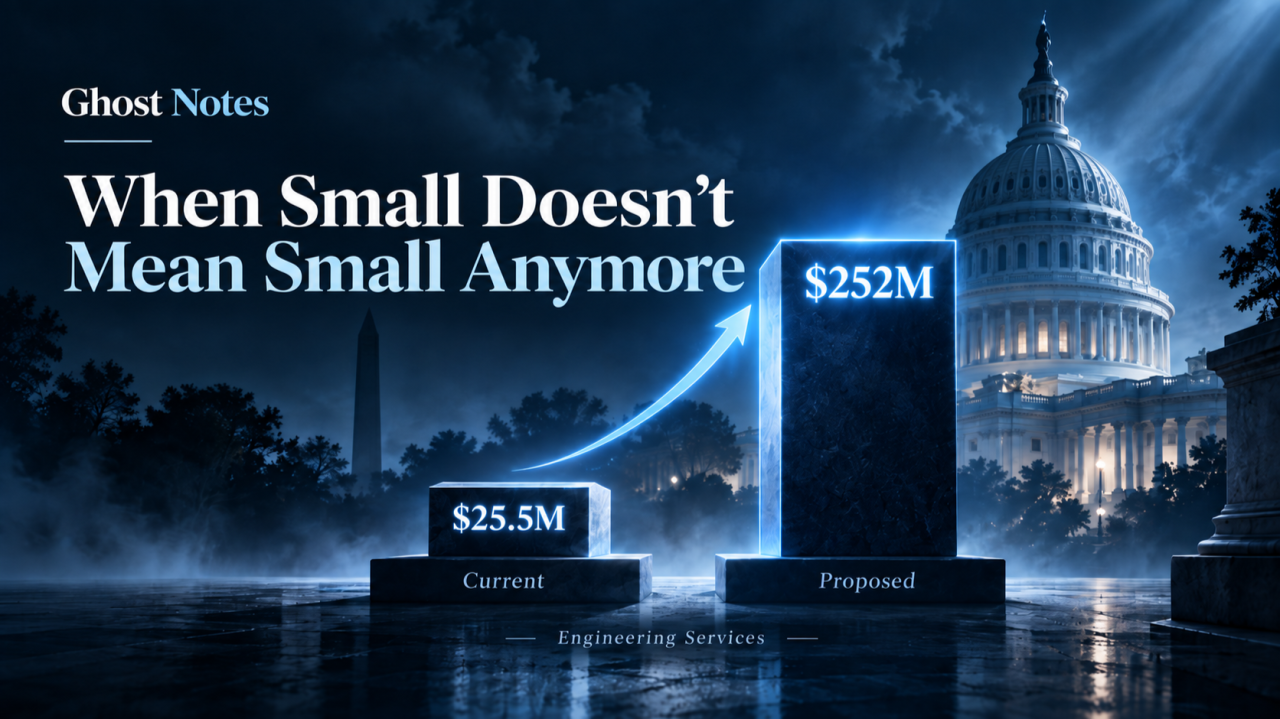
But the SBA’s proposed size standard changes got my attention. Particularly the proposed change to Engineering Services. Today, a company in that category is considered small up to $25.5 million in annual revenue. The proposal would increase that threshold to $252 million. That’s a pretty significant jump.
When I first read it, I had one of those moments where you go back and make sure you didn’t accidentally move a decimal point in your head.
“Nope.”
“It’s really $252 million.”
That immediately led me to the question many small business owners are asking:
What happens if “small business” suddenly includes companies ten times larger than many of today’s small businesses?
I don’t know that anyone knows the answer yet.
But it’s worth discussing.
One thing that makes this conversation interesting is that these size standards matter primarily in government contracting. In the commercial world, customers generally don’t care whether your company does $5 million, $25 million, or $250 million in revenue.
They care whether you can solve their problem. Can you deliver? Can they trust you? Will you answer the phone when they call?
That’s usually the test.
Government contracting works differently. Size standards influence who can compete for certain opportunities, who qualifies for set-asides, and how agencies meet their small business goals.
So when the definition of “small” changes, it has ripple effects throughout the marketplace. Not because larger companies are bad. Not because they’re unqualified. But because the nature of the competition changes.
A company doing $20 million annually looks very different from a company doing $250 million annually. Different resources. Different infrastructure. Different proposal teams. Different capital. Different ability to absorb risk.
That’s just reality.
If these changes move forward, companies will adapt. They always do.
Some will look at mergers and acquisitions as a path to greater scale.
Some will build strategic partnerships and pursue more opportunities together.
Some may decide to diversify into commercial markets and reduce their reliance on government contracts.
Others may simply decide that the federal market no longer aligns with where they want to take their business.
I suspect we’ll see some combination of all of the above. Because businesses are remarkably good at adapting when the environment changes. The question is whether adapting causes companies to lose sight of what made them successful in the first place.
As I thought about all of this, I kept coming back to something that’s easy to forget during industry discussions. Customers don’t wake up in the morning wondering about your size standard.
They’re thinking about their mission. Their priorities. Their challenges. Their deadlines. Their problems.
And they’re looking for partners who can help.
I’ve met plenty of successful government contractors over the years. The best ones rarely won because they were the biggest. They won because they understood the customer better than everyone else. They knew the mission. They had invested time in relationships. They understood the agency’s priorities. They delivered consistently.
And when something went wrong, they didn’t hide from it.
That’s true at $5 million. It’s true at $25 million. And it’s still true at $250 million.
Whether the SBA ultimately adopts these changes or not, there’s a lesson here. External conditions will always change. Regulations change. Administrations change. Budgets change. Markets change.
What matters is whether we stay focused on the things we actually control. Do your homework. Learn the agency. Understand the mission. Build relationships before you need them. Provide a great customer experience. Execute consistently. Do business the right way.
Those things aren’t listed in any NAICS code. They’re not part of any size standard calculation.
But they’ve always been the foundation of successful businesses, whether they’re serving government customers or commercial customers.
The companies that survive major shifts are usually the ones that never stop focusing on their customers.
And that’s probably as true today as it’s ever been.
________________________________________
The SBA’s proposed rule is currently open for public comment through September 21, 2026.
If you have thoughts on how these proposed changes could impact your business, employees, customers, or the broader small business community, consider submitting a comment.
Submit comments here: https://www.regulations.gov/commenton/SBA-2026-0199-0001
Rule information and comments docket: https://www.regulations.gov/docket/SBA-2026-0199
Whether you support the proposal, oppose it, or simply want to share your perspective, participating in the process is one of the few ways business owners can help policymakers understand the real-world impact of these decisions.


©2026 Ghostwerks. All rights reserved. Privacy Policy. Terms of Use.