
When I wrote this late last night it made perfect sense to me that I was pointing the finger directly at myself, not a partner, teammate, employee, or collaborator. In recent days:
I still feel that the article is true to me and could be insightful to other small businesses that feel like there are never enough hours in the day, week, month, or year to get everything accomplished. That’s why it is important to bring in the right staff, build the repeatable processes, and let the people do the work that you hired them for. I need to quit being the bottle neck. Hard lesson. One that has been hitting me on the forehead lately.
I hope some of the issues that I am dealing with, resonate with other small businesses.
This week, my work looked glamorous in the way a filing cabinet looks glamorous.
There were conversations about an NDA. A JV agreement in progress. A few LLC-related details that needed to be “simple” (which is the first sign they won’t be). And a small mountain of receipts that apparently reproduced overnight.
None of it would make a good movie.
But it did remind me of something I keep learning the slow way in GovCon:
Most partnerships don’t fall apart because someone had bad intentions. They fall apart because someone got casual with the basics.
And the basics are rarely exciting.
Here’s the friction: relationships run on trust, but execution runs on proof.
In the early days of teaming, especially when you’re building toward a JV or partnering on an opportunity, everyone wants to talk about the big things:
But the partnership is quietly being scored somewhere else. It’s being scored in the tiny moments:
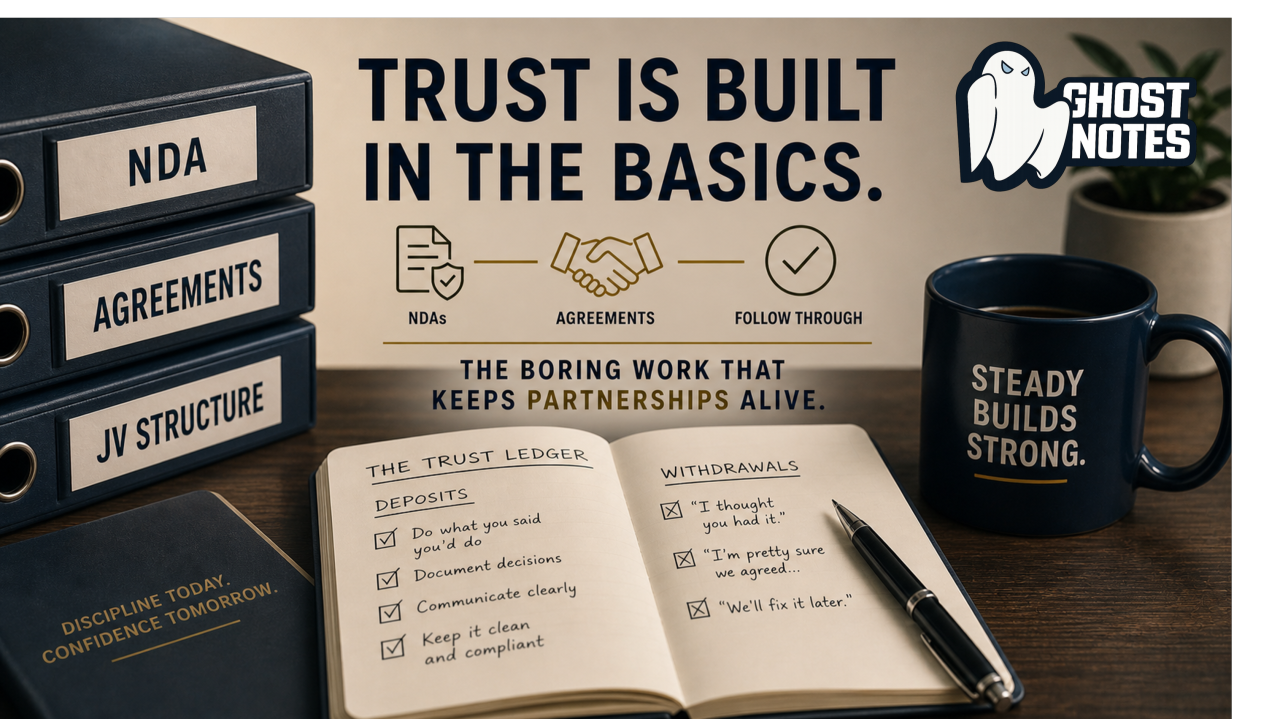
Trust is built in the boring parts. And in GovCon, the boring parts are where your risk lives.
You can have an impressive capability statement and still lose a partner’s confidence because you can’t produce a clean paper trail when it matters.
At one point this week, I caught myself thinking:
“If I have to ask for the same document one more time, I’m going to start labeling files the way people name boats. This one will be called ‘NDA_Final_FINAL_RealFinal_UseThisOne.’”
And then the quieter thought showed up right behind it:
“If this is annoying now, what happens when money is moving?”
That was the moment. Because it’s not the NDA that’s the issue. It’s not the receipts. It’s the signal.
Small administrative discipline is often the earliest indicator of whether a partnership will hold under real pressure.
When things get tense, pricing, scope, performance, invoicing, people don’t suddenly become more organized, more fair, or more accountable.
They become more themselves. So the “minor” stuff isn’t minor. It’s rehearsal.
I’ve started thinking of trust like a ledger. Not because trust is transactional, it shouldn’t be. But because trust is measurable in outcomes. Deposits look like this:
Withdrawals look like this:
And here’s the part that matters for leadership:
If you want to be trusted with the big things, contracts, JV structures, prime relationships, you have to be trustworthy with the small things.
Because the small things are how other leaders assess your operating system.
Not your intent. Not your ambition. Your operating system.
Three practical moves I’m using right now
Some weeks, leadership looks like big meetings and bold direction. Other weeks, leadership looks like:
It’s not glamorous. But in GovCon, the people who survive the long game usually aren’t the loudest. They’re the steadiest. And steadiness is mostly just doing the boring things, on purpose, before you’re forced to.


©2026 Ghostwerks. All rights reserved. Privacy Policy. Terms of Use.