
When I attended VIP START earlier this year, I wasn’t completely convinced I belonged there. Ghostwerks was still small, and stepping away from the company for three days felt like a significant commitment. There was work to be done, customers to support, and a small team where being gone for three days was noticeable.
There was also another thought in the back of my mind: START is for people starting businesses. I’ve already started one. That thought didn’t survive the three days. I came away from VIP START with plenty of useful nuggets. Some reinforced things I already knew. Others exposed things I didn’t know nearly as well as I thought I did.
Just as important were the conversations with the other Veteran business owners in the room. I wrote after START that relationships are the work, and I still believe that.
Seven months later, I walked into VIP GROW with a very different mindset. This time, I was ready to step away.
A lot can change in seven months. Ghostwerks had grown. We had more employees, more customers, more opportunities and, with all of that, more responsibility.
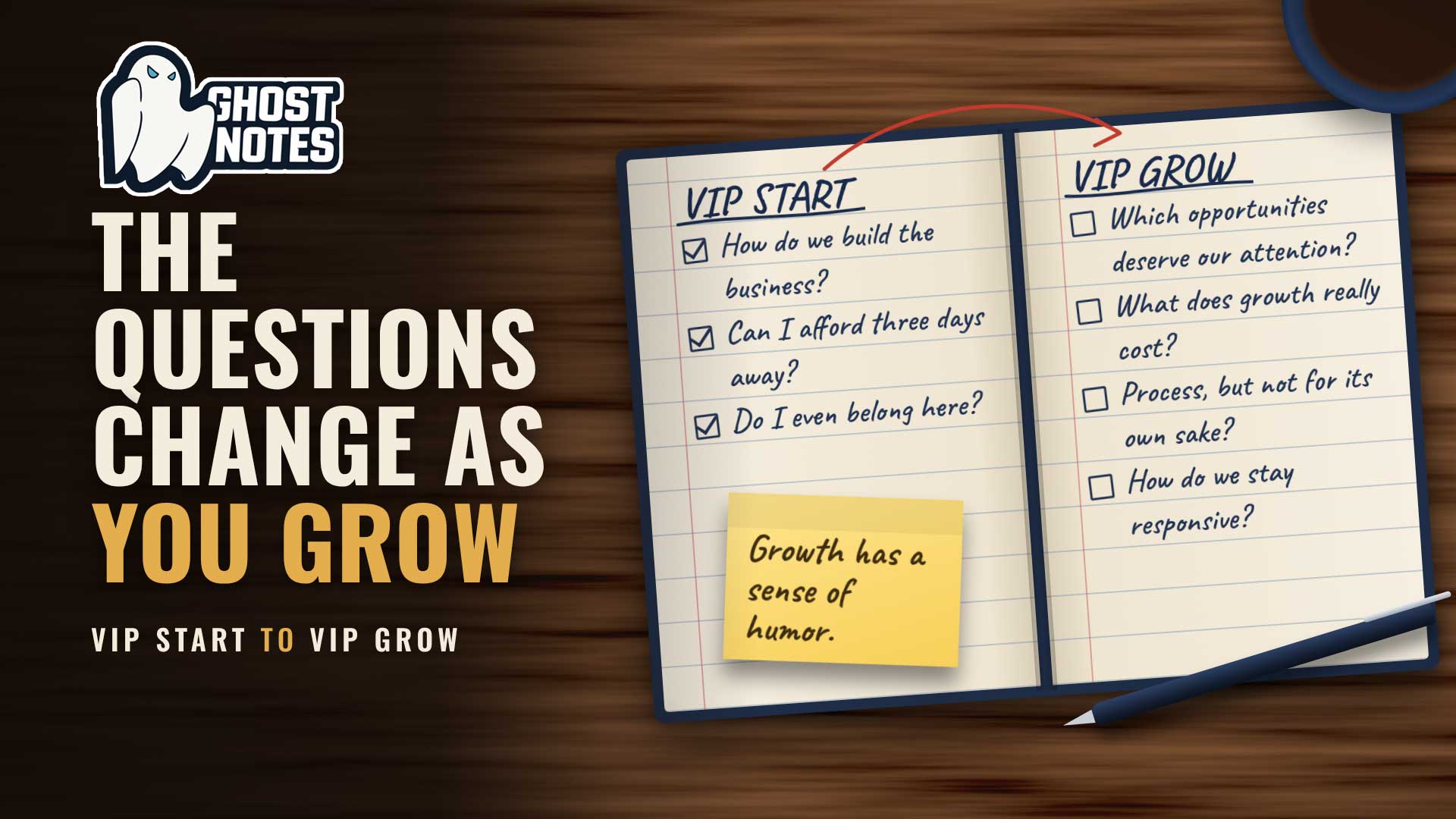
The questions had changed, too. At START, a lot of my questions were about building the business. At GROW, I found myself thinking about how we build it deliberately.
And perhaps the uncomfortable questions every founder eventually has to ask:
Several VIP GROW sessions brought those questions into sharper focus for me.
Aaron Moak’s Strategic Management & Planning session made me think more deliberately about where Ghostwerks is going and what has to change to get there.
The Financing Solutions Panel gave me another perspective on having the financial capacity to support growth rather than simply reacting to it.
Guy Timberlake’s Habits for Winning in Federal Contracting reinforced how much successful execution comes down to disciplined habits practiced consistently.
Donna M. Dominguez’s session on Indirect Rates brought attention to something decidedly less glamorous, but no less important: understanding what the work actually costs.
Somewhere in the middle of all those notes, I had a fairly simple realization: Congratulations. The company is growing. Apparently, that means I get a completely new list of things to worry about.
Growth has a sense of humor.
One of the questions I’ve been thinking about is how we create the processes a growing company needs without creating process simply because growing companies are apparently supposed to have more of it. I’m learning that part of the answer is knowing where I am not the expert. Rather than trying to become one, I should bring in people who are.
One example is bringing Katie Reilman into Ghostwerks as our Director of Human Resources. Katie understands HR better than I do. She has been building out our HR processes and improving our employee handbook as the company grows. My job isn’t to become the HR expert. My job is to make sure we have the right expert, that she understands where we’re trying to go, and that she has the room and support to build what we actually need.
That has also forced me to think differently about the team itself. When you’re small, responsibilities tend to find whoever is standing closest to them. That works. Until it doesn’t.
Growth requires us to become more intentional about who owns what, where decisions should be made, and where we need expertise instead of another task added to someone’s plate.
The same thinking applies to our customers. Being responsive has been one of Ghostwerks’ strengths, and I don’t want growth to become the reason we lose it.
We’re working to establish an environment where our customers and partners have at least two points of contact within Ghostwerks who can quickly address questions or get something moving. That may sound like a small operational decision. I don’t think it is.
It means knowledge and relationships don’t reside with a single person. A customer shouldn’t have to figure out who is traveling, who is unavailable, or who happens to know the answer before they can get help.
We also communicate frequently with our Contracting Officer’s Representatives. Those conversations are not just about reporting what happened last month. They help us understand what the customer is dealing with today and what may be coming next. That has been a significant factor in our growth.
Some of our opportunities haven’t started with an RFP landing in an inbox (if you are waiting for that you are late to the game). They have started with a conversation in which a customer tells us about another problem they are trying to solve and asks, essentially: Can you help us with this too?
That question only comes after you’ve done something else first: built trust. Responsiveness is one of the ways you keep earning it.
VIP GROW also made me think about two additional questions:
Those are harder.
When you’re building a small business, being involved in nearly everything can be useful. You know the customers. You know the contracts. You know the people. Decisions can happen quickly because there’s a pretty good chance the person who needs to make the decision is already in the room. Often, that’s you. But the behavior that helps you build a small company can eventually constrain a growing one.
I need to stop assuming that because I started Ghostwerks, I need to personally own every part of how it operates. Bringing people like Katie into the company is part of that evolution. So is creating multiple customer points of contact. So is making responsibilities clearer across the organization. And I am still working through this.
If an employee, customer, or partner routinely has to wait for me before something can move, I have to ask a fairly uncomfortable question: Am I adding value here, or am I simply standing in the middle of the road? The answer probably changes depending on the situation. But asking the question is becoming increasingly important.
The value of a program like VIP isn’t measured by how many pages of notes you bring home. I’ve brought home plenty. The real test is what changes afterward. For me, VIP GROW wasn’t about walking away with a completely different business strategy. It was about seeing more clearly what my role needs to become as Ghostwerks grows. In practice, that means:
The relationships matter here, too. The relationships I started building with my VIP GROW classmates have already created follow-on conversations. Some may eventually create opportunities to work together. Others may simply become people I can call when I’m wrestling with something they’ve already experienced. Both have value.
Federal contracting has plenty of formal rules about how companies work together. Trust isn’t one of them. You still need it.
I went to VIP START wondering whether I could afford to spend three days away from the business. I went to VIP GROW believing I couldn’t afford not to. That may be the clearest indication of what changed between the two programs. The questions changed because Ghostwerks changed.
Increasingly, I think my job isn’t to have every answer. It is to recognize which questions matter, put the right people around the table to answer them, and then make sure we actually do something about what we learn.
The questions will change again. I hope they do.


©2026 Ghostwerks. All rights reserved. Privacy Policy. Terms of Use.